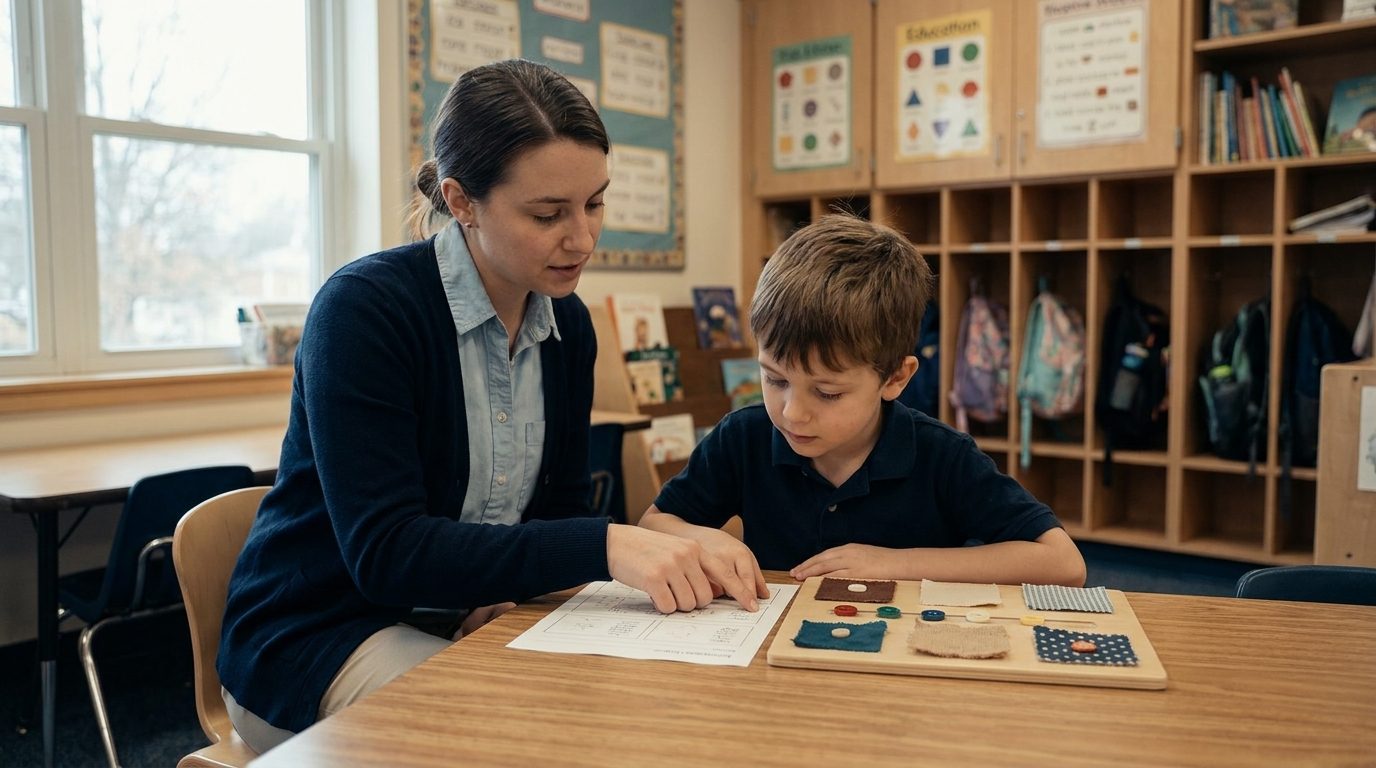
A behavioral technician provides intensive, full-day one-on-one support for students with higher-needs behavior plans — often combining behavioral support with personal care, toileting, transitions, and data collection — under a supervising professional’s direction. Blue Horizons Aides staffs behavioral technicians, with Registered Behavior Technician (RBT) placement available on request, subject to placement requirements, for schools across Southern California.
A Behavioral Technician from Blue Horizons provides intensive, one-on-one support for students with higher-needs behavior plans — prepared for assignments involving behavioral support, personal care, toileting, transitions, and data collection, working under the direction of the classroom teacher, school psychologist, or Board Certified Behavior Analyst (BCBA) who oversees the student’s Behavior Intervention Plan (BIP). Every Behavioral Technician we place has passed DOJ Live Scan fingerprinting and reference checks before ever stepping into a classroom. Districts and families also search for this role as a behavior intervention technician, behavioral aide, or ABA-trained aide — Blue Horizons places all of these under our Behavioral Technician service.
How This Differs From a Behavioral Support Aide
Both roles implement a student’s Behavior Intervention Plan under the direction of the school’s IEP or behavior team — the difference is intensity and scope. A Behavioral Support Aide supports a student during the specific moments their IEP behavioral goals target. A Behavioral Technician is built for a higher-needs assignment: sustained one-on-one support across the full school day, often paired with personal care, toileting, and transition support alongside the behavioral component, and more detailed data collection to feed back into the student’s plan.
What a Behavioral Technician Does
- Implements the strategies written into the student’s Behavior Intervention Plan, under the teacher’s or BCBA’s direction
- Provides sustained one-on-one support across the full school day, including higher-needs assignments involving personal care and toileting where a student’s plan calls for it
- Supports safe, consistent transitions between activities, classrooms, and settings
- Collects detailed behavioral data — frequency, duration, and antecedent/consequence notes — through daily attendance, timesheets, and journals
- Coordinates with the classroom teacher, BCBA, school psychologist, and family so the plan is applied the same way, every period, every day
Areas of Behavioral Technician Support
Depending on what a student’s plan calls for, a Behavioral Technician placement can focus on any combination of the following:
- School-based behavior intervention — implementing an approved BIP consistently across the school day
- Autism support — classroom participation, communication routines, and reinforcement strategies for students on the autism spectrum
- Intensive behavior support — sustained one-on-one coverage for higher-needs behavior plans
- Behavioral data collection — frequency, duration, and ABC (antecedent-behavior-consequence) documentation feeding back into the student’s plan
- Emotional regulation support — helping a student recognize and manage emotional responses per their plan
- Crisis prevention and de-escalation support — verbal de-escalation techniques to prevent a difficult moment from escalating
- Elopement and safety support — maintaining appropriate proximity, following a student’s safety plan, and alerting district personnel per approved procedures
- Social-skills support — reinforcing peer interaction and social participation strategies already built into a student’s plan
Every one of these is implemented under the direction of the classroom teacher, BCBA, or school psychologist who designed the plan — a Behavioral Technician carries it out, not a substitute for that team’s clinical direction.
Behavioral Technician and Registered Behavior Technician (RBT) Services
Blue Horizons offers Registered Behavior Technician (RBT) placements as part of our Behavioral Technician services, available upon request and subject to placement requirements, for districts and families whose student’s plan specifically calls for a BACB-certified RBT. An RBT holds certification through the Behavior Analysis Certification Board (BACB) — a national credential focused on delivering structured, plan-based behavior support. Contact us to discuss RBT placement for your specific student or program.
Where This Fits Among Our Aide Types
Instructional Aide
Academic support tied to a student’s IEP goals, under the classroom teacher’s direction. See Instructional Aide Services.
Behavioral Support Aide
Support during the specific moments a student’s behavioral IEP goals target. See Behavioral Support Aide Services.
Behavioral Technician (including RBT)
Sustained, higher-needs one-on-one support — behavioral, personal care, and transitions combined — for the full school day, with RBT placement available where a plan requires it.
All are paraprofessional placements screened, trained, and supervised through the Blue Horizons Standard — and not a substitute for the BCBA, school psychologist, or IEP team who design a student’s plan.
Who Needs a Behavioral Technician
Schools & Districts
Special education programs with a student whose BIP calls for sustained, higher-intensity one-on-one support across the school day — not just during specific periods — and who need a placement that can also handle personal care and transitions without a second aide.
Families
Parents whose child’s plan involves complex behavioral needs alongside personal care or toileting support, and who want confidence that one consistently trained person — not a rotating aide — is with their child throughout the day.
The Blue Horizons Standard
Every Behavioral Technician we place goes through the same standard as every Blue Horizons aide: Screen (DOJ Live Scan fingerprinting and reference checks), Train (structured onboarding plus ongoing retraining for higher-needs behavioral and personal-care support), Supervise (a multi-layer supervision model with a named single point of contact from senior management), and Verify (real-time attendance and performance data feeding our Quarterly Performance Review Program).
Frequently Asked Questions
Do you offer RBTs (Registered Behavior Technicians)?
Yes. RBT placement is available upon request, subject to placement requirements. Contact us to discuss RBT placement for your specific student or program.
Does a Behavioral Technician replace the BCBA or school psychologist?
No. The Behavioral Technician implements the Behavior Intervention Plan under the direction of the teacher, BCBA, or school psychologist who designed it — they don’t design or revise the plan.
How is this different from a Behavioral Support Aide?
A Behavioral Support Aide supports a student during specific targeted moments in the day. A Behavioral Technician is built for a higher-needs, full-day assignment that often combines behavioral support with personal care and transition support. Contact us to talk through which fits your student’s plan.