
“Special education paraprofessional” is one of those job titles that means something slightly different in every district, and the written job description rarely captures the whole picture. If you’re considering the role, hiring for it, or trying to understand what the aide in your child’s classroom is actually responsible for, this is a plain description of the work: what a paraprofessional does day to day, what California requires to hold the position, which certifications matter, and what the job typically pays.
What a Special Education Paraprofessional Actually Does
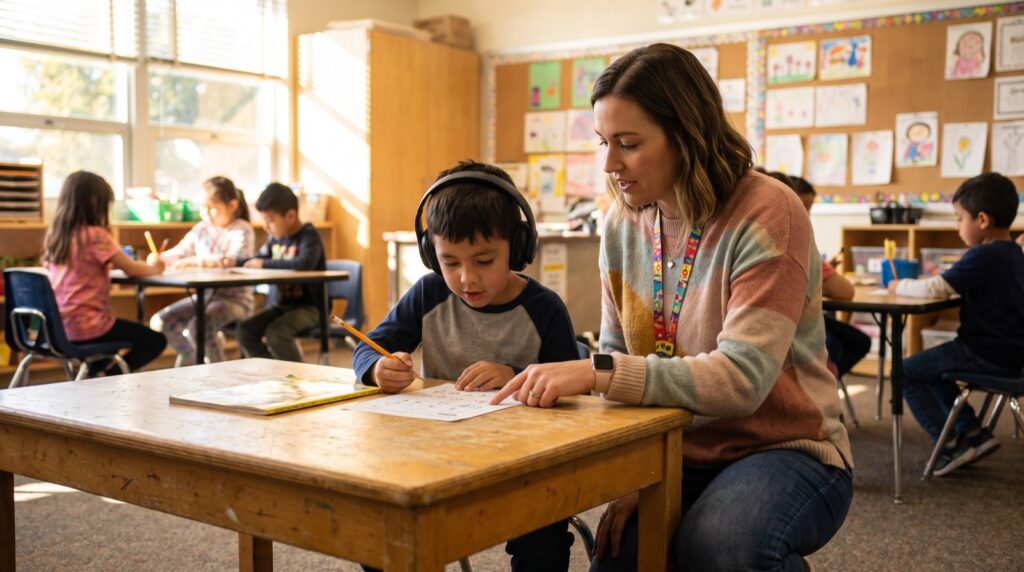
A special education paraprofessional — also called an instructional aide, paraeducator, teacher’s aide, or classroom aide depending on the district — works under the direction of a credentialed teacher or service provider to help students with disabilities access their instruction. The paraprofessional does not design the curriculum, write the IEP, or make placement decisions. They carry out a plan that someone else is legally responsible for, and they do it in close, sustained contact with one student or a small group.
The distinction between an aide and the professionals who direct the work matters, and it’s worth understanding before taking the job. We cover it in more detail in Instructional Aide vs. Teacher’s Aide vs. Paraeducator and What Is an Instructional Aide in California Schools?
Core Duties and Responsibilities
Most special education paraprofessional job descriptions in California come down to some combination of the following, weighted differently depending on the assignment:
- Instructional support. Reteaching or reinforcing a lesson the teacher has delivered, breaking tasks into smaller steps, reading directions aloud, scribing, prompting a student back on task, and adapting materials in the moment so a student can participate.
- Behavioral support. Implementing the strategies in a student’s behavior plan — not writing the plan — which can include prompting replacement behaviors, using a reinforcement system consistently, redirecting, and following a specified de-escalation sequence when a student escalates.
- Personal care. For some assignments, assistance with toileting, feeding, mobility, transfers, or hygiene. This is assignment-specific and usually requires additional training and health clearances before a paraprofessional can provide it.
- Data collection. Recording frequency, duration, or accuracy data on IEP goals and behaviors so the teacher and IEP team can measure progress. This is a bigger part of the job than most people expect. Our guide to how IEP goals are measured and tracked explains what that data is used for.
- Supervision and safety. Monitoring a student during transitions, recess, lunch, PE, and specials; keeping a student who elopes within a safe area; and being the adult who notices early when something is going wrong.
- Communication. Reporting to the supervising teacher, keeping a daily log where required, and passing along observations that belong in front of the IEP team — without independently interpreting them as clinical findings.
Assignment Types
The same job title covers very different day-to-day realities. Common assignment types include:
- One-to-one (1:1) aide. Assigned to a single student whose IEP calls for dedicated support. See One-on-One (1:1) Aide Placement.
- Classroom or shared aide. Supporting a special day class or resource room as a whole, or a small group within a general education classroom.
- Inclusion aide. Supporting one or more students with disabilities inside a general education setting so they can participate in the least restrictive environment.
- Behavioral aide. A behavior-focused assignment, often tied to a formal behavior intervention plan. Where the need is more intensive, districts may use a behavioral technician instead.
- Personal care aide. Assignments centered on health and personal-care needs, with the additional training that requires.
- Extended School Year (ESY). Summer assignments for students whose IEPs include ESY services.
What the Job Is Not
A clear job description is as much about boundaries as duties. A special education paraprofessional does not diagnose disabilities, write or revise the IEP or behavior plan, design instruction, make independent decisions about a student’s program, or provide medical care beyond what they are specifically trained and assigned to do. The paraprofessional’s judgment is real and valuable — they often know the student’s patterns better than anyone — but it feeds a team process rather than replacing it.
Minimum Requirements in California
To work as a special education paraprofessional in a California public school, you generally need to meet the following. Individual districts can add requirements on top of these.
- Age and education. Typically at least 18 and a high school diploma or equivalent.
- The paraprofessional academic requirement. For paraprofessionals working in Title I settings, federal law requires one of: completion of at least two years of college (often defined as 48 semester units), an associate’s degree or higher, or a passing score on a formal local assessment of instructional knowledge and skills. Many California districts use a paraprofessional proficiency exam for candidates who don’t have the college units.
- Background clearance. Fingerprint-based criminal background checks through the California Department of Justice and FBI via Live Scan. Our explainer What Does DOJ Background Clearance Mean for School Staff? walks through what that involves.
- Health clearances. A tuberculosis (TB) risk assessment or test, and any immunization documentation the district requires.
If you’re starting from zero, How to Become an Instructional Aide in California lays out the steps and rough timeline.
Certifications and Training That Help
None of these are universally required, but they make a candidate more employable and are often required for specific assignments:
- Crisis prevention and de-escalation (for example CPI training) for behavioral assignments.
- CPR, First Aid, and AED certification.
- Mandated reporter training, which California requires of school staff.
- Paraprofessional supervision and support training under California’s AB 1172, covering how aides are trained and supervised.
- Registered Behavior Technician (RBT) credential for behavior-intensive roles, though that is a distinct national certification — see Behavioral Technician vs. RBT.
The training a well-run staffing provider layers on top of the minimums is described in Training and Preparation Our Aides Receive.
Typical Pay in California
Special education paraprofessional pay in California is generally hourly and follows a school-year calendar, which means annual earnings depend heavily on how many hours and days you work. As a rough guide, hourly rates commonly fall somewhere in the high-teens to mid-$20s per hour, with meaningful variation by district, region, assignment, and experience. Personal-care and behavior-intensive assignments, bilingual ability, and additional college units or credentials tend to move pay upward.
Because the numbers shift so much by employer and location, it’s worth reading our full breakdown: How Much Do Instructional Aides and Paraprofessionals Make in California? Always check the specific district’s published classified salary schedule for exact figures.
Work Schedule and Conditions
Most paraprofessional roles follow the student calendar — roughly 180 to 190 workdays — with summers off unless you pick up ESY work. Hours are often part-time or just under full-time, which is a deliberate district budgeting choice and one of the main reasons the role has high turnover. The work is physically active, emotionally demanding, and, done well, genuinely consequential for the students you support.
How the Role Fits Into the IEP Team
The paraprofessional is usually the team member with the most contact hours with the student and the least formal authority over the plan. That combination makes clear communication essential: the aide sees what’s working and what isn’t, and the value of that only lands if it’s reported to the supervising teacher and, where relevant, brought to the IEP team. Parents can support this dynamic too — Supporting Your Child’s IEP Team as a Parent covers how.
It also helps to understand where the paraprofessional sits relative to the credentialed professionals. The special education teacher or case manager is responsible for the instructional program and the IEP itself. Related-service providers — a speech-language pathologist, occupational therapist, behavior specialist, school psychologist — own their respective assessments and service plans. The paraprofessional carries out pieces of all of those under direction, which is why the same aide might follow a communication strategy set by the SLP in the morning and a reinforcement schedule set by the behavior specialist in the afternoon. Knowing whose plan you’re implementing at any given moment, and who to ask when something isn’t working, is a large part of doing the job well.
The Hardest Parts of the Job
An honest job description includes the parts that wear people down, because they’re the reason turnover in this role is high:
- Emotional load. You spend the day with a student who may be frustrated, dysregulated, or struggling, and you absorb a lot of that without a natural outlet for it.
- Physical demands. Standing, kneeling, moving quickly, and for some assignments lifting, transferring, or managing a student in crisis safely.
- Ambiguity. You’re often asked to use judgment in the moment without full information, then to report it accurately without over-interpreting it.
- Being underestimated. Paraprofessionals frequently know a student better than anyone else on the team and still have the least say. That gap is real, and the best teams narrow it by actually listening to aide observations.
- Pay and hours. The role is usually part-time by design and modestly paid, covered in detail in the pay guide linked above.
People who last in this work tend to be the ones who find the daily contact with students genuinely rewarding and who land in a placement with real support behind them.
Questions to Ask Before You Accept an Assignment
- Who directly supervises this assignment, and how often will I actually see them?
- Is there a current behavior plan or health-care plan I’ll be implementing, and will I be trained on it before day one?
- Is this a 1:1, a shared, or a classroom assignment, and how many students am I realistically responsible for?
- What data am I expected to collect, and on what system?
- What’s the schedule — days, hours, and whether it includes ESY?
- What happens when the student I support is absent?
Clear answers are a good sign. Vague ones usually mean you’ll be figuring it out alone.
How to Get Started
If you’re a school or district writing this role into a job posting, or a candidate who meets the requirements above and wants to be placed, Blue Horizons Aides recruits, screens, trains, and supervises Instructional, Behavioral Support, and Sensory Support Aides across Southern California. You can review current openings on our careers page, or get in touch to talk through a specific assignment.