
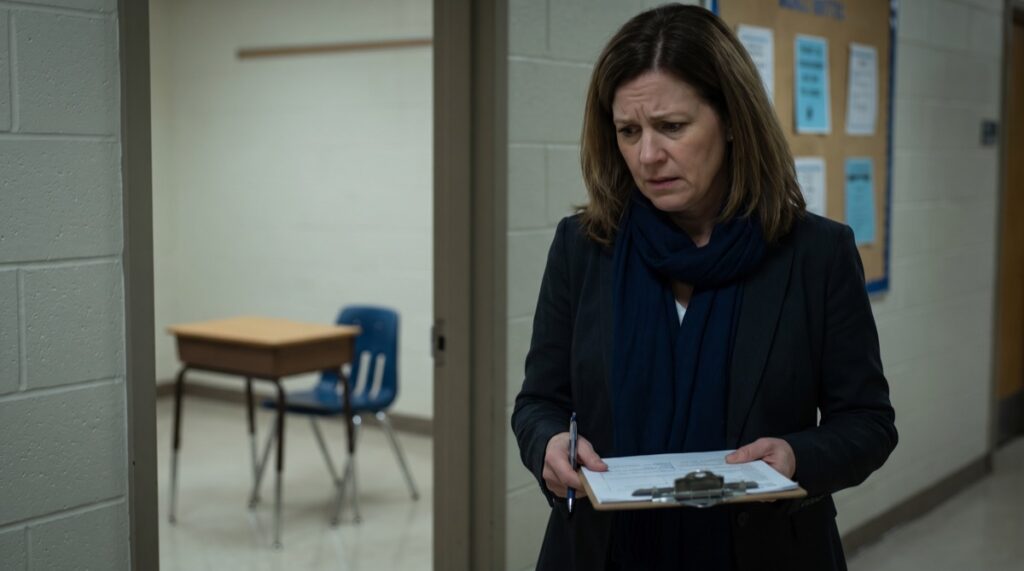
Most school districts don’t leave a staffing vendor over a single dramatic failure. They leave after a slow accumulation of small ones — a call that goes unanswered, a substitute who shows up without the right briefing, a report that never arrives. Individually, each of these looks survivable. Together, they’re the pattern that precedes a vendor switch, and it’s worth being able to name the pattern before it costs a semester of disrupted placements.
Why This Is Harder to Spot Than It Sounds
Part of what makes a struggling staffing vendor hard to identify is that the failures rarely show up as failures. They show up as minor friction that everyone absorbs without naming: a coordinator who fields a parent’s question themselves because the vendor’s rep didn’t respond in time, a teacher who does extra onboarding with a new aide because the vendor’s briefing was thin, a principal who quietly extends patience to a vendor because switching feels like more work than tolerating. None of these moments individually looks like a vendor problem. Collectively, they’re exactly that — work that’s being done by district staff because a staffing partner isn’t doing it, without anyone tracking how much of it has accumulated.
That’s why this list is framed around specific, checkable signs rather than a general feeling that “something’s off.” A feeling is easy to talk yourself out of. A specific, unanswered question — who is our point of contact, what is our Live Scan status, how fast is your replacement turnaround — is much harder to rationalize away.
1. You Don’t Know Who to Call
The clearest sign a staffing relationship has broken down is structural: there’s no single person at the vendor who actually knows your district, your school sites, or your history with a given placement. Instead, every call routes to a general line, and every conversation starts from zero. If your special education coordinator can’t name, off the top of their head, the specific account manager responsible for your district’s placements, that’s not a minor inconvenience — it’s a sign the vendor has scaled past the point where they can actually manage relationships, only transactions.
This is one of the more fixable problems, but only if you know to ask for it directly. A staffing partner should be able to name a single point of contact for your account on your first call, not your fifth. See how we structure this on our Single Point of Contact page.
2. You Can’t Get a Straight Answer on Background Clearance Status
Ask your current vendor, right now, for the exact Live Scan clearance status of every aide currently placed in your district — not “they’re all cleared,” but the actual status of each individual. If the answer takes more than a day to produce, or comes back vague, that’s a warning sign worth taking seriously. A vendor that can’t produce this information quickly either doesn’t track it centrally, or doesn’t want to show you what it would reveal. Either way, you’re being asked to take compliance on faith rather than on evidence.
Our own DOJ Live Scan process, run through our authorized applicant-agency status, is documented in detail on our DOJ Live Scan & Compliance Explained page — and status on any individual placement should be available to a district on request, not on a delay.
3. Replacement Coverage Takes Longer Than It Should
Every staffing arrangement will eventually need a replacement — an aide who leaves, gets sick, or simply isn’t the right match for a specific student. What separates a functioning vendor relationship from a failing one isn’t whether replacement is ever needed; it’s how fast a qualified replacement actually shows up once it is. If your current vendor’s answer to “we need someone new by Monday” is routinely “we’ll see what we can do,” that’s a vendor operating without a real bench — which means every placement they’ve made is one resignation away from becoming your emergency.
We built our 24-Hour Service Center specifically to close this gap, because the alternative — a district scrambling to cover a mandated position with no fallback plan — is the scenario every SPED coordinator is trying to avoid.
4. Aides Show Up Without Assignment-Specific Preparation
General screening and general training are the floor, not the ceiling. A vendor that treats every placement as interchangeable — sending a generally qualified aide without briefing them on the specific student’s IEP, BIP, health plan, or communication needs — is setting that placement up to struggle from day one, regardless of how well-intentioned or capable the individual aide is. If you’re consistently having to do the assignment-specific onboarding yourself, on top of what you’re already paying a vendor to handle, that’s a sign the vendor’s process stops short of where it needs to.
What thorough, assignment-specific preparation should actually include is outlined on our Training and Preparation Our Aides Receive page.
5. You Have No Visibility Into Attendance or Performance Until Something Goes Wrong
The best time to learn an aide isn’t showing up reliably is the first week it happens — not the week a parent calls to ask why their child’s support has been inconsistent. A vendor relying entirely on your district to flag problems, rather than proactively tracking attendance, timesheets, and performance on their own end, is outsourcing quality control back to you without telling you that’s what’s happening. Ask whether your current vendor has a structured review process at all, and how often it actually runs.
Our Quarterly Performance Review Program exists because waiting for a complaint to surface a performance issue is always more expensive — in compliance risk and in trust — than catching it proactively.
A Composite Scenario
Consider a mid-sized district with fifteen aide placements across four school sites, all through the same vendor. In September, a one-to-one aide for a student with an active BIP resigns with two days’ notice. The district calls its vendor’s general line, waits four hours for a callback, and is told a replacement “should be available within a couple of weeks.” In the meantime, the site principal covers the gap informally, pulling a general classroom aide off other duties — which technically leaves the BIP unimplemented as written, and creates a second, quieter compliance problem on top of the first. Three weeks later, a replacement arrives, but with no assignment-specific briefing on the student’s plan, so the classroom teacher spends the first several days re-explaining basics the vendor should have covered before day one.
Nothing about this scenario involves a single dramatic failure. It’s five small ones, stacked, and by the time the district notices the pattern, a student has gone three weeks without properly implemented behavioral support and a principal has absorbed work that was never supposed to be theirs. This is the shape most vendor failures actually take — not one bad decision, but an accumulation of smaller gaps that a stronger operational process would have caught at step one.
What to Do If You’re Seeing These Signs
None of these five signs, on its own, is necessarily disqualifying — every vendor has an off week. What matters is the pattern. If you’re seeing two or more of these consistently, across multiple placements and multiple months, that’s not a staffing hiccup; it’s a structural gap in how the vendor operates, and it’s unlikely to resolve itself without a change on your end. The good news is that switching staffing partners mid-year, while it sounds disruptive, is a well-worn process — our Vendor Onboarding for School Districts page walks through what a clean transition actually looks like, including how to avoid a coverage gap during the switch itself.
It’s also worth having a direct conversation with your current vendor before assuming the relationship is unsalvageable. Ask specifically: who is our named point of contact, what is our current Live Scan status across all placements, and what is your actual replacement turnaround time. A vendor with strong operational practices will answer all three quickly and specifically. A vendor without them will answer vaguely, or not at all — and that answer, or lack of one, tells you most of what you need to know.
Questions Worth Asking Before You Sign With Anyone
Whether you’re evaluating a new vendor or re-evaluating your current one, the same five questions map directly onto the five warning signs above: Who is our named point of contact? What is your Live Scan clearance process, and how do you report status? What is your actual replacement turnaround time, in writing? What does assignment-specific preparation look like before an aide’s first day? And what is your structured process for catching performance issues before they become complaints? A vendor that answers all five with specifics, rather than reassurances, is one worth trusting with a compliance-sensitive placement. Our own answers to all five are outlined across our Questions to Ask Before Hiring an Aide Agency page, built specifically so districts have a framework for this evaluation regardless of who they ultimately choose.
The Bottom Line
A staffing vendor’s real value isn’t visible on a good day — it’s visible on the day something goes wrong, and how fast and how transparently they respond. If your current relationship can’t answer basic questions about who’s responsible, who’s cleared, and how fast a gap gets covered, that’s the pattern worth acting on before it turns into a semester of disrupted placements. If you’d like a second opinion on what you’re currently seeing, reach out to our team — we’re glad to walk through it, whether or not you end up working with us.