
Every student with Down syndrome brings their own personality, strengths, and pace to the classroom. This page offers a general, respectful overview of classroom support considerations that IEP teams commonly discuss for a student with Down syndrome — it is not medical or diagnostic guidance, and every student’s plan should be built around their own IEP team’s assessment of that individual child.
Common Classroom Support Considerations
IEP teams working with a student with Down syndrome often look at a few recurring areas when building a support plan. None of these are universal — they’re starting points for a conversation between the teacher, the family, and any related-service providers involved.
- Individualized instructional pacing — breaking lessons into smaller steps, allowing extra processing time, and revisiting concepts through repetition and hands-on practice.
- Communication support — reinforcing spoken language with visuals, gestures, or augmentative communication tools where the IEP team has identified a need.
- Social inclusion — structured opportunities to participate alongside classmates in group work, recess, and school activities, rather than working in isolation.
Instructional Pacing and Communication in Practice
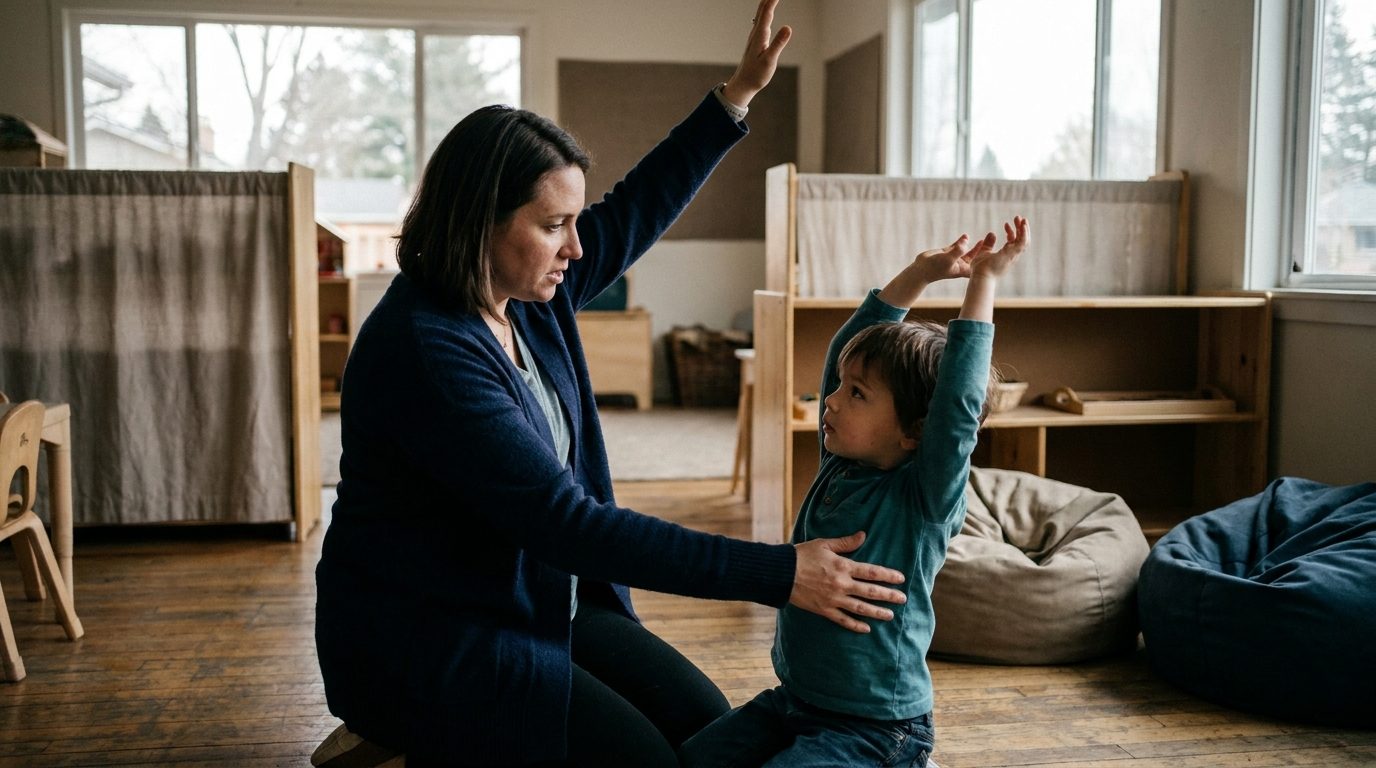
In practice, individualized pacing might mean an aide sits with a student during independent work time to break a multi-step assignment into smaller pieces, check understanding before moving forward, and give the student a bit more time to process and respond — all under the classroom teacher’s direction and aligned to the student’s IEP goals. Communication support is similarly practical: reinforcing a lesson with a picture schedule, modeling a phrase before asking the student to use it, or supporting whatever communication approach the student’s IEP team and speech-language provider have already put in place.
Supporting Social Inclusion
Social inclusion is often just as important to families as academic progress. An aide can help by prompting turn-taking during group activities, facilitating an introduction on the playground, or quietly stepping back once a peer interaction is going well — the goal is participation alongside classmates, not separation from them.
For School Staff
A Blue Horizons aide works under your direction and the student’s IEP, reinforcing the pacing, communication approach, and inclusion strategies your team has already designed — not replacing your instructional decisions.
For Families
You know your child best. A Blue Horizons aide is there to support the plan your child’s IEP team has built, with consistent, qualified support your family can count on day to day.
How a Blue Horizons Instructional Aide Supports This
A Instructional Aide from Blue Horizons is placed to carry out the pacing, communication, and inclusion supports the IEP team has already outlined — not to set new goals independently. Day to day, that can mean sitting alongside the student during instruction, reinforcing communication strategies established by the speech-language provider, and supporting participation in group and social settings, always under the classroom teacher’s direction. Every aide we place has passed DOJ Live Scan fingerprinting and reference checks before entering a classroom, and continues under ongoing supervision after placement.
The Blue Horizons Standard
Every aide we place follows the same standard, regardless of the classroom: Screen (DOJ Live Scan fingerprinting and reference checks), Train (structured onboarding plus ongoing retraining), Supervise (multi-layer supervision with a named single point of contact), and Verify (real-time attendance and performance tracking feeding our Quarterly Performance Review Program). Families and school teams get a documented, accountable process behind the person in the classroom — not just an assurance.
Frequently Asked Questions
Does a Blue Horizons aide decide what support my child receives?
No. Support strategies are set by the student’s IEP team — the aide’s role is to carry out that plan consistently under the classroom teacher’s direction. See what to expect from a Blue Horizons aide for more on how that day-to-day relationship works.
Who do we talk to if we have questions about our assigned aide?
Every placement includes a named single point of contact from senior management, backed by our 24-hour service center. Contact us to talk through your school’s or family’s specific situation, or visit our homepage to learn more about how Blue Horizons works.