
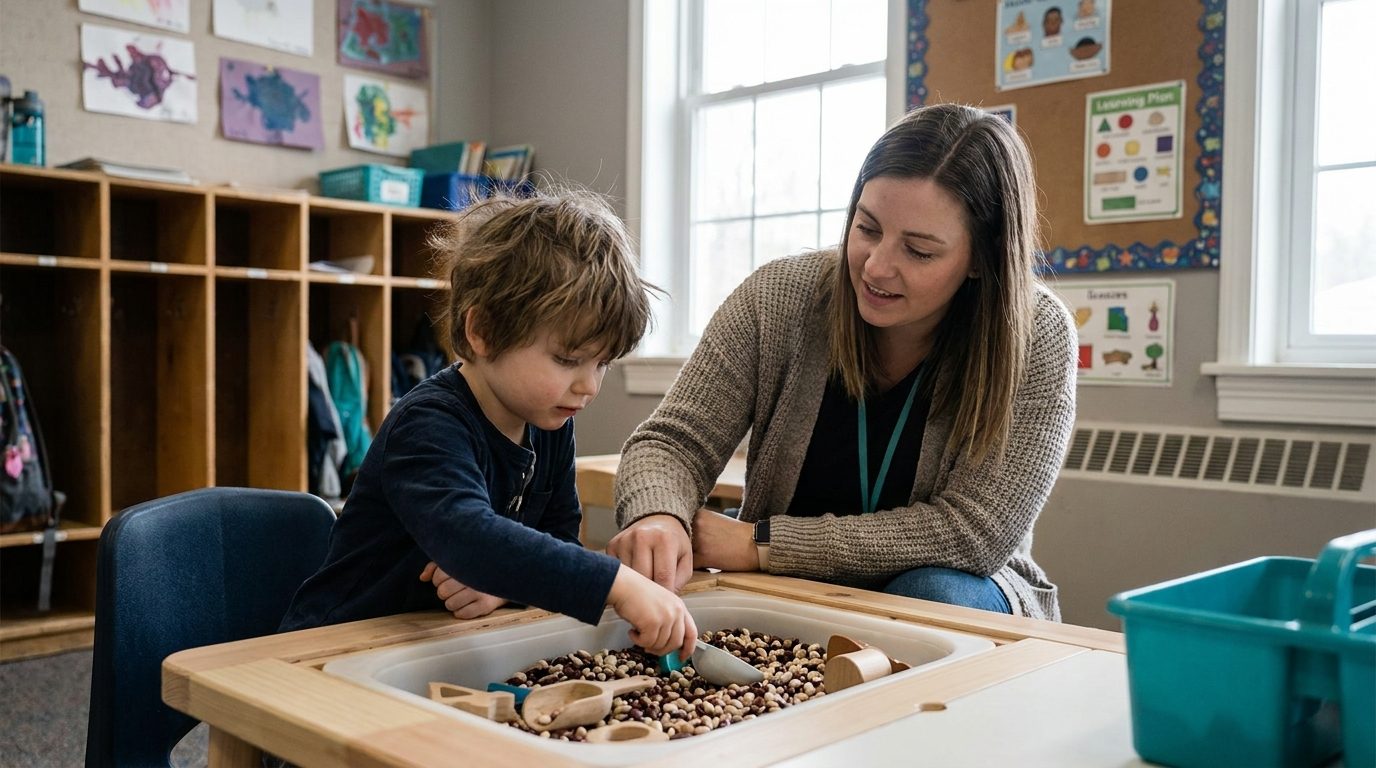
A student with a visual impairment can thrive academically and socially in a general education classroom when the right support is in place. That support usually involves several people working together: a Teacher of the Visually Impaired (TVI) who adapts materials and sets goals, an orientation and mobility (O&M) specialist who teaches safe movement through the building and campus, the classroom teacher, and often a Blue Horizons Instructional Aide who provides the consistent, in-classroom presence that keeps the plan running day to day. This page is a general educational overview for parents and school staff — it is not medical or clinical guidance, and any questions about a specific child’s vision, diagnosis, or IEP goals should go to the student’s ophthalmologist, TVI, and IEP team.
What Classroom Support for Visual Impairment Usually Involves
- Awareness of the student’s orientation and mobility needs — knowing their established routes, cues, and any mobility tools so the classroom and school day stay predictable
- Reinforcing material adaptations the TVI has already set up (large print, braille, tactile graphics, audio, or assistive technology) rather than creating new adaptations independently
- Consistent, familiar support from one aide who understands the student’s routines, seating, and preferred way of receiving information
- Clear communication between the classroom teacher, the TVI, the O&M specialist, and the family so nothing about the student’s plan gets lost between people
Orientation and Mobility Awareness in the Classroom
Orientation and mobility instruction — teaching a student how to move safely and independently through their environment — is delivered by a credentialed O&M specialist, not by a classroom aide. What an aide can do is stay aware of the routes, cues, and independence goals that specialist has already established, and support them consistently: keeping walkways clear, using the same verbal or physical cues the student already knows, and giving the student room to practice independence rather than stepping in unnecessarily. Consistency between the O&M plan and everyday classroom routine is often what makes the difference between a student who gains confidence moving through their school and one who has to relearn the environment every time something changes.
Material Adaptation Support Alongside a TVI
A Teacher of the Visually Impaired designs how a student accesses classroom materials — large print, braille, tactile diagrams, screen readers, or other assistive technology. An aide’s role is to support that plan in real time: making sure adapted materials are on hand and set up before a lesson starts, helping the student use the tools and formats the TVI has already trained them on, and flagging back to the TVI and teacher when something isn’t working so the plan can be adjusted by the people qualified to adjust it. This keeps the classroom experience smooth for the student without duplicating or working around the TVI’s specialized instruction.
Why Consistency Matters
Many students with a visual impairment rely on routine — a familiar voice, a known layout, a predictable sequence of cues — to move through their school day with confidence. An aide who is present consistently, rather than a rotating cast of substitutes, is often what allows those routines to hold. That is one reason the assignment and supervision of an aide matters as much as the aide’s day-to-day tasks.
How a Blue Horizons Instructional Aide Supports This
A Instructional Aide from Blue Horizons works under the direction of the classroom teacher and the student’s IEP team, including the TVI and O&M specialist where applicable. The aide reinforces the adaptations and routines those specialists have already established — rather than replacing their expertise — and provides the steady, familiar presence that helps a student with a visual impairment stay oriented, supported, and included in general education activities. Every aide we place has passed DOJ Live Scan fingerprinting and reference checks before entering a classroom.
The Blue Horizons Standard
Every aide we place goes through the same process before and during service: Screen (DOJ Live Scan fingerprinting and reference checks), Train (structured onboarding plus ongoing retraining), Supervise (a multi-layer supervision model with a named single point of contact), and Verify (real-time schedule, attendance, and performance tracking feeding our Quarterly Performance Review Program). You can read more about how that DOJ Live Scan screening works, or reach our team directly with questions about a specific placement.
Blue Horizons provides skilled and knowledgeable instructional aides who genuinely care about our students’ success. Their commitment to ongoing training and supervision has resulted in a successful SPED program.
Laura M., SPED Teacher
If your school or family would like to discuss classroom support for a student with a visual impairment, contact Blue Horizons or visit our homepage to learn more about our aide types and screening process.